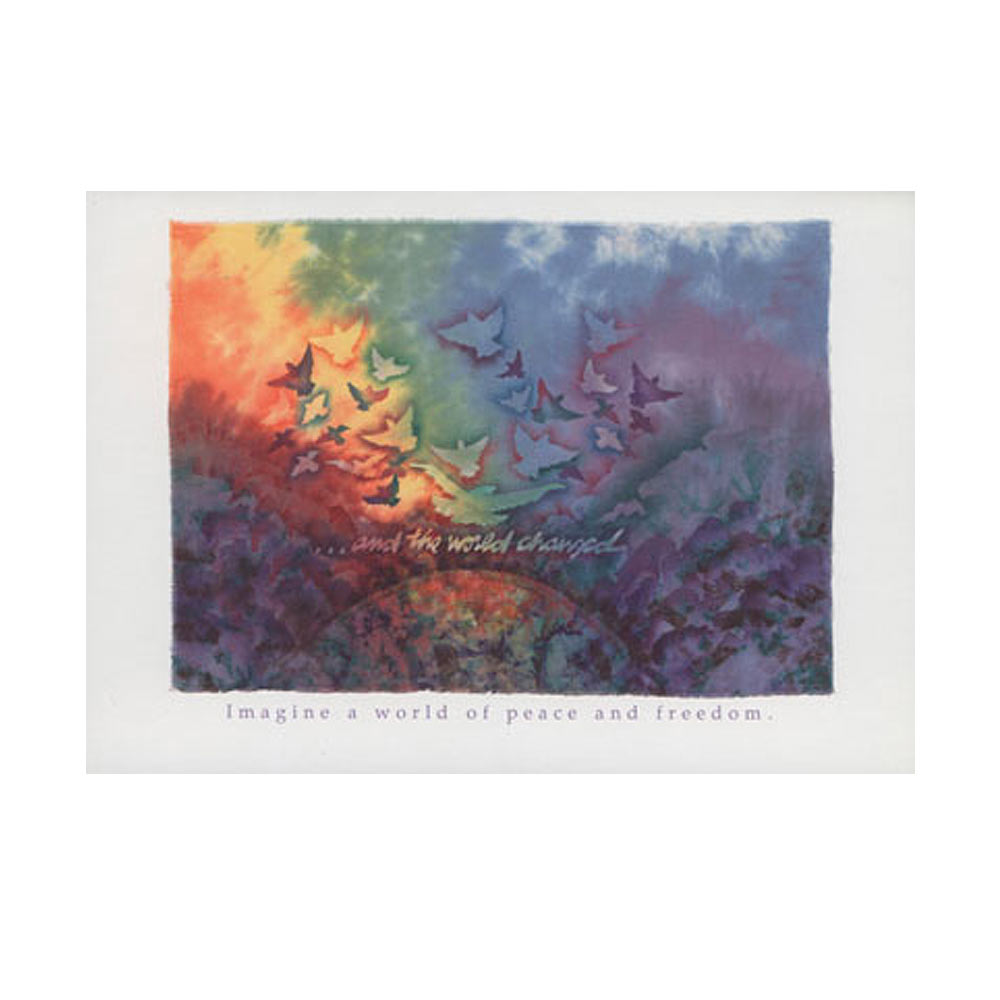
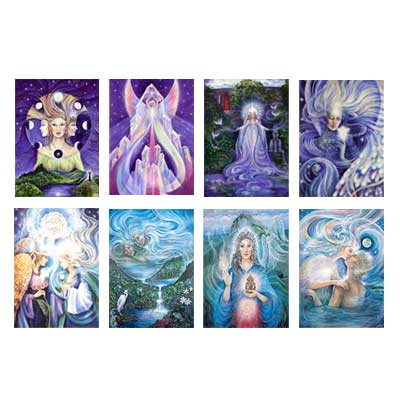
5x7 Blank Peace Cards
Click any image for Larger View
Inspirational and decorative,
these lovely, high quality cards have messages appropriate to our
time and every time. For details on art work and verses please go
to the poster pages of the
individual cards (except the World Peace Card which has details below).
The Cards are 5"x7" and
blank on the inside.
World Peace card Details:
There are fewer than 20 writing systems in the world, about 100 written
languages and over 5000 spoken languages, all of which has complicated
language representation on the Peace Card. The languages were selected
with these criteria:
* recent areas of conflict (Arabic for Palestine, Iraq and other Middle
Eastern countries, Hebrew for Israel, Pashto for Afghanistan)
* permanent members of the United Nations' Security Council (China,
England, France, Russia, United States)
* representation from each continent
* indigenous representation (Mayan, Inuit, Hawaiian, Onondagan)
The Peace Card, like peace itself, is an intricate weave that honors
diversity and celebrates the world community. It speaks the language
of peace.
Listed below are the words for peace and their origins:
* PEACE: English — Australia, Canada, England, USA.
* AMAN: Urdu — Pakistan, India.
* AMNIAT: Pashto — Afghanistan, Pakistan.
* *SALAM: Arabic — spoken by almost 200 million people in more
than 22 countries, from Morocco to Iraq, and as far south as Somalia
and the Sudan. Also by Palestinians in West Bank and Gaza.
* *HE PING: Mandarin — China, particularly the northern, central
and western regions, and Taiwan.
* UXOLO: Xhosa — South Africa.
* *SHANTIi: Hindi — one of the 15 “national languages” of
India, a country with 1,683 “mother tongues” and 850 languages
in daily use.
* AMANI: Swahili — Kenya, Uganda, Tanzania, other countries of
east and southern Africa.
* DAMAI: Indonesian — the approximate 6,000 inhabited islands
of the Indonesian archipelago which straddles the Equator between the
Indian and Pacific oceans.
* PACE: Italian — Italy.
* AMAITHI: Tamil — southern India, Sri Lanka, South Africa, Malaysia,
Singapore.
* SAQ: Uighur — central Asia, including China (the Xinjiang Uighur
Autonomous Region), Turkestan and Uzbekistan.
* BAKÉ: Basque (Euskara is the name of the language) — border
provinces between France and Spain.
* SIPALA: Hawaiian — the speaking and teaching of Hawaiian was
suppressed from the late 19th through most of the 20th century. In
1978, Hawaiian was made an official language of the state of Hawaii;
by 1987, public schools were again allowed to teach the language.
* SULH: Dari — along with Pashto, one of the two official languages
of Afghanistan. About 1/3 of the population speaks Dari and it serves
as the means of communication between speakers of different languages.
* PAKE: Albanian — is spoken by about 6,400,000 inhabitants of
the eastern Adriatic coast in Albania, and the former Yugoslavia, principally
in Kosova and Macedonia. There are perhaps 300,000 more speakers in
isolated villages in S. Italy.
* MUSANGO: Duala (Dhuwal) — one of more than 200 Australian indigenous
languages, most of which have been destroyed or live only in the memories
of the elderly.
* RUKUN: Javanese — first language for more than 75.5 million
people mostly from Indonesia.
* PAIX: French — principal spoken language in Belgium, Benin,
Burkina-Faso, Burundi, Cameroon, Canada, Central African Republic,
Chad, Comoros, Congo, Djibouti, France, Gabon, Guinea, Haiti, Ivory
Coast plus the Canadian province of Quebec.
* PACI: Maltese — closest languages are Maghrebi Arabic, Syrian,
Lebanese and Palestinian; the only Semitic language which is written
in the Roman alphabet.
* ETSÓAÓANÓLAO: Mayan language family — includes
many languages that are spoken in Mexico, Guatemala and Belize by 1.5
million Mayan speakers.
* HEIWA: Japanese — Japan; a language of uncertain origin, believed
to be linked to both Altaic languages (Turkish, Mongolian, etc.) and
also Austronesian languages like Polynesian. Although the Japanese
language uses Chinese characters as one of its writing systems, Chinese
is a completely different language whose pronunciation and grammar
are completely different and cannot be understood by a Japanese person
unless they have studied it.
* FRED: Danish — Denmark, Greenland, Iceland and the Faroe Islands.
* SIDI: Tibetan — Tibet, Bhutan, Nepal and parts of northern
India. It is written in a script based on the writing system of the
ancient Sanskrit language of India.
* JAM: Fula — throughout west Africa. Most speakers are found
within a band running from Senegal to northern Cameroon, including
also the countries of Mauritania, Gambia, Guinea, Guinea Bissau, Mali,
Burkino Faso, northern Benin, Nigeria, Niger and Chad.
* HASÎTÎ: Kurdish — Turkey, Syria and the countries
of the former Soviet Union, as well as Iraq and Iran. It is most closely
related to the various dialets of Persian, to Pashto spoken in Afghanistan
and Pakistan, and to Baluchi spoken in Pakistan.
* PAN: Catalan — a large area in eastern Spain, Andorra, the
south of France, and Majorca.
* NIMUHORE: Ruandan — a Bantu language spoken in Rwanda, Tanzania,
Uganda and Zaire.
* *MIRE: Russian — predominant language within the borders of
the Russian Federation, with an estimated 25 million additional speakers
living outside its borders in its newly independent neighbors. In some
countries, such as Armenia, ethnic Russians constitute less than 1%
of population, while in others, such as Kazakhstan, Russian speakers
number 40%.
* POKÓJ: Polish — Poland, with many speakers also in the
US, the Ukraine and other former republics of the Soviet Union.
* PAZ: Spanish — language of Spain, Mexico and all Latin America
except Brazil with 250 million speakers worldwide.
* HOÂ BINÎ: Vietnamese — Viet Nam and about 2 million
Vietnamese living overseas.
* KAAPAYAPAAN: Tagalog — national language of the Philippines.
* TUTKIUM: Inuit — known as the Eastern Eskimo language. It is
spoken in northern Alaska, Canada and Greenland.
* *SHALOM: Hebrew — official language of Israel. However it is
primarily used for religious and ceremonial rather than common language
purposes.
* NIRUDHO: Pali — ancient language of India from the Indo-Aryan
group. The earliest of the Buddhist literature is in Pali.
* SKAÑNOÑH: Onondagan — spoken language of one
of 5 indigenous nations that formed Iroquois Confederacy (Haudenosaunee)
in what is now called New York State in USA.
* In these languages Peace is shown in its written form on the card
and transliterated to the Latin alphabet in the explanation.
ORDERING:
Order on Line: Click on a "buy" button
above to add that item to your Secure
Shopping Cart (powered by Mal's eCommerce). Master
Card and Visa accepted.
By Mail: Simply
send a check for the correct amount to Yoga Life Style,
116 Costa Road, Highland, NY 12528. Be sure to specify
each item you want, and include your name, address and
phone number. Note: the easiest way to collect this information
is to use the shopping cart, proceed to calculate tax and
shipping, then print and mail that page.
By Phone: If
you prefer to call in your order please call The Greenberg
Publishing Group at 845.883.4220 between
9AM and 5PM Eastern Time Monday thru Friday. Master Card
and Visa are accepted.
Link for Details
on Domestic US Shipping and Handling.
Link for Details
on Canadian Shipping and Handling.
Link for Details on Other International
Shipping and Handling.
Any questions call the number above
or email poster@YogaLifeStyle.com
|